
SCH Tokenomics
Breaking down SCH's tokenomics and functionalities

SCH
SCH is Schwap’s native governance, value accrual, and rewards token. SCH provides a wide array of functionality, both for the protocol and the user which enables novel mechanism and incentive design for Schwap. SCH’s design puts a unique twist on critical traditional-financial concepts to build a valuable and sustainable token.
Tokenomics
SCH’s maximum supply is 1,000,000 tokens, of which, tokens are distributed as follows:
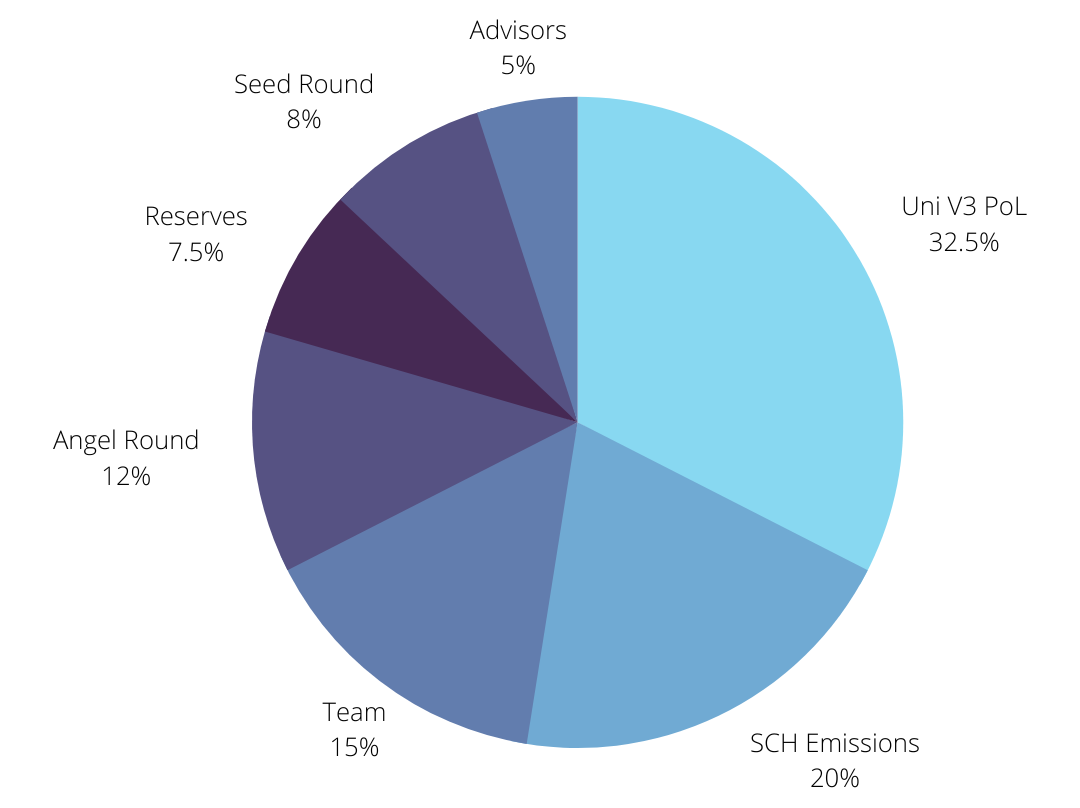
32.5% (325,000 SCH): Uniswap V3 Liquidity
20% (200,000 SCH): SCH Emissions
15% (150,000 SCH): Team Allocation
12% (120,000 SCH): Angel (Pre-Seed) Round Allocation
8% (80,000 SCH): Public (Seed) Round Allocation
7.5% (75,000 SCH): DAO Treasury Reserves
5% (50,000 SCH): Advisory Allocation
Issuance
SCH’s token issuance schedule was designed with two main principles in mind:
Long investor-vesting schedules only result in sustained sell pressure, stopping the token from flourishing
DeFi tokens are far too inflationary. SCH was designed to be minimally inflating and to do so over a long period
As such, the relevant vesting schedules are as follows:
The Schwap team’s 150,000 token allocation is vested linearly over 4 years with a 1 year cliff (33.3% distributed per year thereafter).
Angel and seed round participants have been placed on a 4 week linear vesting schedule, wherein 25% of allocated tokens can be claimed at the token’s launch, and 25% more will become available each week thereafter until completion. Angel and seed round allocations will be claimable through a dApp released upon launch.
DAO reserves and advisory allocations remain entirely flexible, and may be issued variably based on the nature and circumstance of their issuance.
Emissions
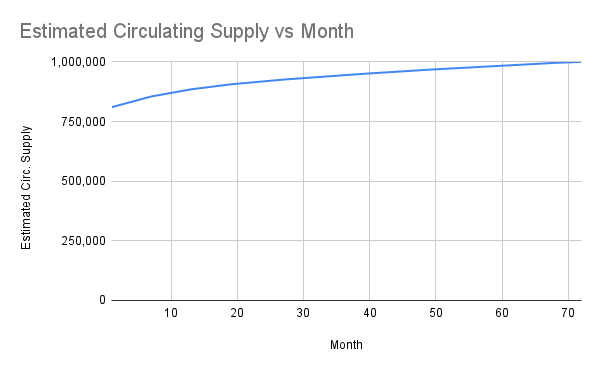
SCH is emitted on an epochal basis, where each epoch is 7-days in length (corresponding to veSCH voting periods).
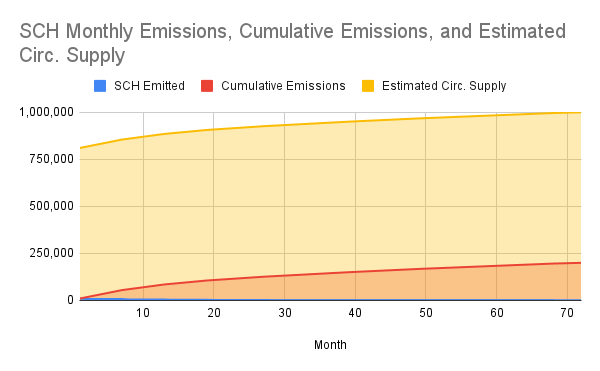
Below (Fig. 2), we see SCH's new emissions per month (blue) versus cumulative SCH emissions over time (red) versus SCH's estimated circulating supply over time (yellow). We quickly see that emissions, although already minimal, quickly taper down. Emissions begin aggressively, in the protocol's earliest-stage, but we see that they quickly taper down into a progressive plateau.
To more clearly see the scale of emissions, we can remove the Estimated Circulating Supply (see; Fig. 3). We quickly notice that while emissions begin steep, they taper down within the first 7 weeks, and continue to do so over the following 7 weeks.
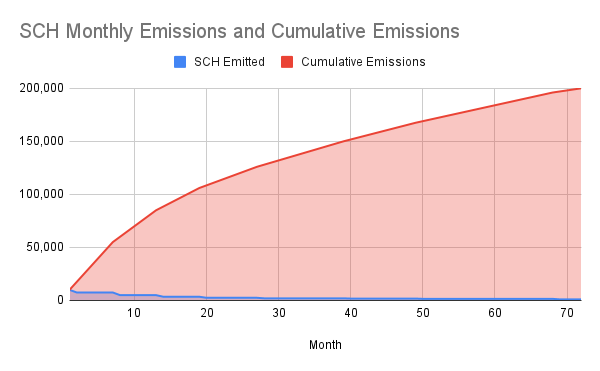
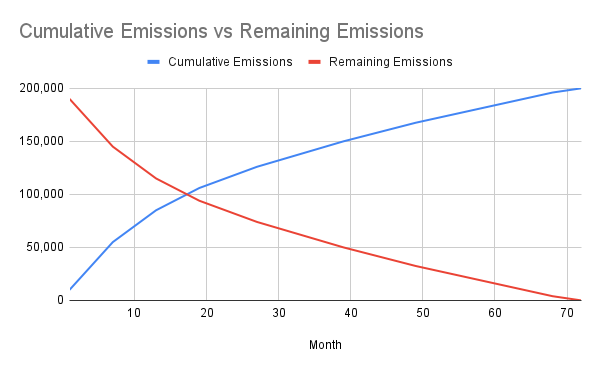
Note: SCH’s full 6 year emissions schedule can be found here.
veSCH
veSCH (vote-escrowed SCH) is SCH's locked derivative. SCH features five different vaults in which holders can lock their tokens with varying lock-durations (between 1 day and 4 years), fee share, and voting power;
1 Day:
Fee share: 0.00%
Vote Power / SCH: 1
6 Months:
Fee share: 5%
Vote Power / SCH: 5
1 Year:
Fee share: 20%
Vote Power / SCH: 10
2 Years:
Fee share: 30%
Vote Power / SCH: 20
4 Years:
Fee share: 45%
Vote Power / SCH: 40
veSCH functions as Schwap’s value accrual and governance token, enabling lockers to earn real-yield, boosted SCH emissions, and govern the protocol’s emissions and changes.
From a governance standpoint, veSCH’s primary purpose is to direct the flow of SCH emissions. Each epoch (7 days), lockers are given the ability to vote on their desired pair for emission accrual, and emissions will thereby be directed to those pairs relative to votes. SCH emissions are used to incentivize trading on Schwap, thus, the accrual of emissions toward a specific pair results in the incentivization of trading on a given pair.
From a yield standpoint, veSCH holders accrue real-yield in ETH alongside boosted SCH rewards for trading. While all Schwap traders earn SCH emissions proportional to their notional volume, traders who hold veSCH earn significantly boosted SCH yields. Additionally, veSCH accrues real-yield driven by Schwap's revenues, where 100% of revenues are reflected back to veSCH, making it one of the most desirable yield-accruing assets in DeFi. Both SCH emission boosts and real-yield are accrued proportional to your lock-up length (1 day → 4 years).
Due to veSCH's ability to incentivize trades on given pairs, bribes become a valid method of maximizing real-yield in ETH. We acknowledge that the majority of active governance participants in any DEX are protocols seeking to incentivize liquidity on their own tokens — individual actors most often seek to maximize their own yield rather than governance participation. To make this process seamless, Schwap uses bribes to direct control of veSCH votes automatically — making the governance process entirely passive and boosting real-yield substantially.
Join Us!
Website: https://schwap.app/
Documentation: https://docs.schwap.app
Discord: https://discord.com/invite/nUc7HcbssV
Twitter: https://twitter.com/0xSchwap